FITT Principle
The FITT Principle
The Four Variables
FITT applies to kettlebell training and to all other kinds of exercise. The elements offer guidelines for structuring your program.
Frequency
Intensity
Time
Type
Frequency
Frequency describes how often you exercise. It can reflect the number of kettlebell workouts per week or month, the number of exercises per workout, the number of sets per exercise, or the number of repetitions per set. For example, if you exercise once a day for 4 days per week, your frequency is four workouts per week. If you exercise twice a day for 3 days per week, your frequency is six times per week.
In order to maintain a healthy body and to become fitter, a general recommendation is to exercise at least 4 days of the week.
Intensity
Intensity refers to how vigorously you perform your kettlebell exercises — the amount of energy or effort needed to execute a particular exercise or session. It can be expressed in several ways.
Kettlebell lifting combines cardiorespiratory training with resistance training, so intensity can be measured as a function of either.
Measuring Cardiorespiratory Intensity
One simple way to measure intensity is to wear a heart rate monitor. Intensity is expressed as a percentage of maximal heart rate (MHR) in beats per minute (BPM). A more intense workout produces a higher heart rate; a less intense workout produces a lower one.
- Men: 220 − age
- Women: 226 − age
Finding Your Pulse
Immediately upon completing your training set, find your pulse by placing your index and middle fingers at one of two locations:
At the Neck
At the Wrist
Count how many beats occur in 15 seconds and multiply by 4 to get beats per minute (BPM). For example, 40 beats in 15 seconds = 160 BPM.
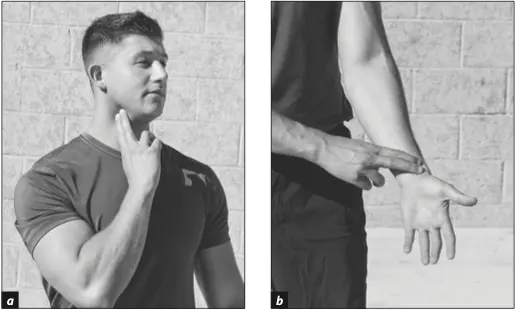
Figure 3.1 Finding your pulse: (a) at the neck or (b) at the wrist.
Heart Rate Training Zones
Warm-Up / Healthy Heart Zone — 50-60%
Fitness / Fat-Burning Zone — 60-70%
Endurance / Aerobic Zone — 70-80%
Performance / Anaerobic Zone — 80-90%
Maximal Effort Zone — 90-100%
- Beginners: Majority of workouts in the healthy heart zone to gradually develop aerobic fitness at manageable intensities.
- After a few weeks: Begin incorporating more workouts in the fitness zone.
- Experienced users: Stay in the fitness and endurance zones for most workouts.
- Advanced / highly fit: Add more workouts in the performance zone with periodic sessions in the maximal zone.
- Everyone: Always warm up in the healthy heart zone.
Measuring Resistance Intensity
Intensity can also refer to the amount of stress an exercise puts on your body — for example, the heaviness of the load. Lifting a 32-kilogram (71 lb) kettlebell is far more intense than lifting a 12-kilogram (26 lb) kettlebell for the same exercise.
Here intensity refers to a percentage of your repetition maximum (RM) — the maximum weight you can lift for a specific number of repetitions:
- 1RM — the maximal kettlebell you can lift for 1 rep
- 10RM — the heaviest kettlebell you can use to complete 10 reps
A heavier kettlebell will always be more intense than a lighter one.
Practical Programming
For general health and fitness, most kettlebell workouts should be of moderate intensity. Beginners are advised to use lighter weights at higher repetitions for safety — a lower-intensity effort for a longer duration. A more highly conditioned athlete will work at higher intensities by using progressively heavier kettlebells.
- Moderate workout: maintain RPE between 4 and 6
- Easy workout: RPE in the range of 2 to 3
Time (Duration)
Time or duration is the length of time you are active in a single kettlebell lifting session — the terms are used interchangeably and usually expressed in minutes. In kettlebell lifting, there is also another important facet of time: tempo, speed, or pace — which affects the total volume of work performed in a given set.
Two Layers of Time
Total Workout Duration
Time Per Set
How Tempo Affects Volume
During some lifts, both time and tempo are calculated. Suppose you do a one-arm press for 2 minutes (1 minute per hand) with a 16-kilogram (35 lb) kettlebell:
Fast — 1 rep / 3s
Moderate — 1 rep / 4s
Slow — 1 rep / 5s
You'll become very familiar with this concept of tempo during your kettlebell workouts.
Take a look at table 3.1. In this table, four different kettlebell lifters each select a different load to train with. The numbers illustrate the workload for a single exercise set. Notice that by changing the variables of load, tempo, repetitions, and duration, we get workloads that are all within the same range of total volume.
Table 3.1 Kettlebell Training Volume Comparison
| Load | Tempo | Reps | Duration | Total Volume (Kg) | |
|---|---|---|---|---|---|
| Lifter A | 12 kg | 24 RPM | 96 | 4 min | 1,152 kg |
| Lifter B | 16 kg | 18 RPM | 72 | 4 min | 1,152 kg |
| Lifter C | 20 kg | 20 RPM | 60 | 3 min | 1,200 kg |
| Lifter D | 8 kg | 25 RPM | 150 | 6 min | 1,200 kg |
Type
Type refers to the type of exercise you're doing — running, walking, kettlebell lifting, and so on. Our focus is on lifting kettlebells, a form of exercise that combines:
Cardiorespiratory Conditioning
Resistance Training
Mobility / Range of Motion
Because kettlebell training combines multiple facets of exercise, it is a time-efficient method for developing all-around fitness.
Targeting Specific Goals
Though kettlebells emphasize a combination of training goals, you can also use them in a way that focuses on one quality over the others.
Maximal Strength
Cardiorespiratory Endurance
Muscle Sculpting / Hypertrophy
All-Around Fitness
Exercise Principles
An introduction to the physiological principles and physical skills that govern every kettlebell training program.
Putting the FITT Principle to Work
How to apply the FITT variables — adapt through overload, adjust when progress stalls, and break plateaus with intensity, variation, rest, and nutrition.