Getting Started With Kettlebell

Important Kettlebell Qualities

What to evaluate when choosing a kettlebell — load, handle, surface, shape, durability, weight, finish, comfort, and price.

Important Kettlebell Qualities

There are a number of qualities to keep in mind when testing and deciding which kettlebell to purchase.

Once you've determined whether your goals are fitness or sport oriented, there are several other differences to consider before deciding which type to buy.

Load

There are two types of load for kettlebells: fixed load and adjustable load.

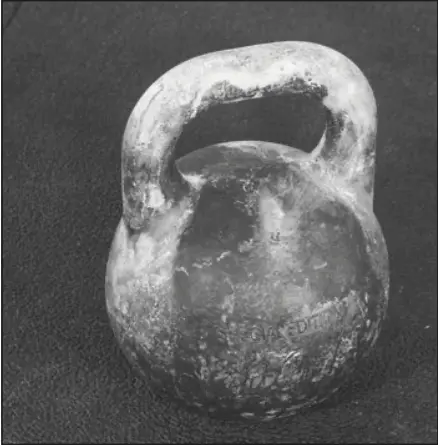
Fixed-Load Kettlebells

One continuous piece — no break between the handle and the bell. The weight never changes, so you'll need a variety of light, medium, and heavy bells. Preferred by serious lifters because no time is wasted changing loads.

Adjustable-Load Kettlebells

Only one bell needed (or two for double-kettlebell work). Cheaper overall, but inconvenient to reconfigure. Two main versions exist: plate-loaded and shot-loaded.
Fixed-load kettlebells are more common and convenient because changing the load every time you want to move up or down in weight is time consuming — you just change kettlebells. Because you need multiple kettlebells for a complete program, fixed-load kettlebells cost more overall than adjustable ones.

Figure 2.3 Fixed-load kettlebell.

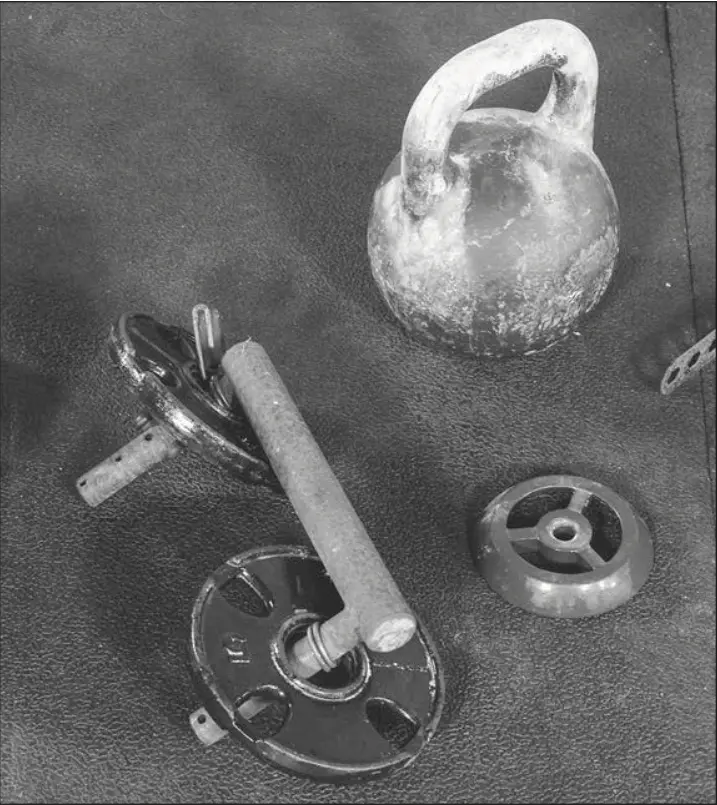
Plate-Loaded Adjustable Kettlebells

There are three types of plate-loaded adjustable kettlebells.

Handle + Plates

Not really a kettlebell at all but still classified as such — a handle attached to weight plates with screws and bolts. One brand is the Kettlestack.

Hard-Plastic Casing

Casing screws apart to reveal slices of hollow and solid plastic. Combine pieces to vary the weight (typically 16 kg / 35 lb up to 32 kg / 71 lb), then bolt the handle and ball back together.

Steel With Internal Rod

Combines plates with a solid steel outer casing. Screw the handle away from the ball to expose a rod that holds stackable weight plates inside.

Figure 2.4 Plate-loaded adjustable kettlebells.

Advantages of adjustable kettlebells: fewer bells to buy (less expensive), and one or two bells take up less space in your training area than a full set of fixed-load kettlebells.
The drawback of adjustable kettlebells is that they are not of the standard dimensions for kettlebell sport, so they cannot be used for competition training.

Shot-Loaded Adjustable Kettlebells

Shot-loaded kettlebells are not so common, but in the early part of the 20th century, they were more popular. They were typically made of metal with a hole and a plug on one side or the bottom, and they were filled with sand, water, lead, or even mercury — used because mercury packs more density (weight) into the bell.

These were the kettlebells used by circus strongmen such as the famous Arthur Saxon and Eugen Sandow.
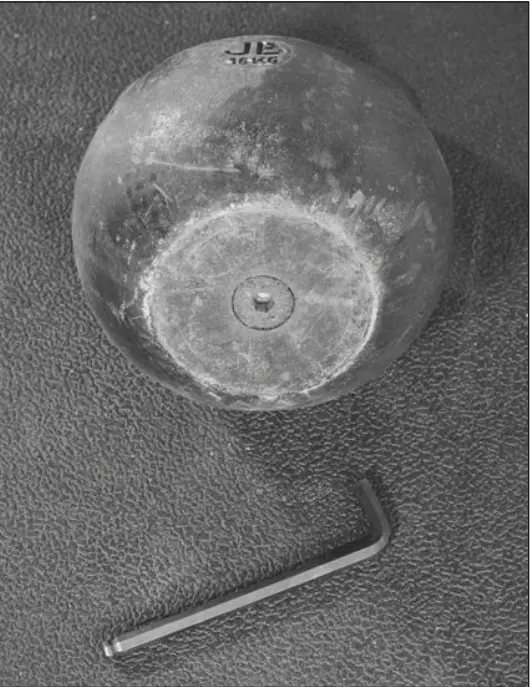
Figure 2.5 Shot-loaded adjustable kettlebell.

Advantage

You still get the feel of real steel in the hands but with only one or two bells, since the load can be adjusted.

Disadvantage

Inconvenient to change the load, messy to add or subtract material, and heavy metals are hard to find — mercury is highly toxic.
A unique feature of shot-loaded bells: if not completely filled, the shot inside will shift around during movement, giving an added training effect as the body adjusts to the changing load. An inexpensive form of steel shot is BBs, found at sporting goods stores carrying hunting equipment. Interesting — but not significant enough to overshadow the convenience of modern fixed-load kettlebells.

Handle Style

The handle is the first and primary part of the kettlebell that you will be in contact with.

You want a handle that almost floats in your hand when you're using it — the right size and thickness, the right amount of spacing between the handle and the bell, and the right texture: not too smooth (slippery) and not too rough (tearing the hands).

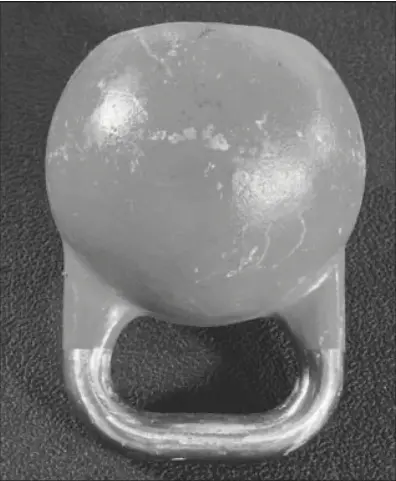
Handles may differ in shape and diameter and may be a single piece or multipiece.
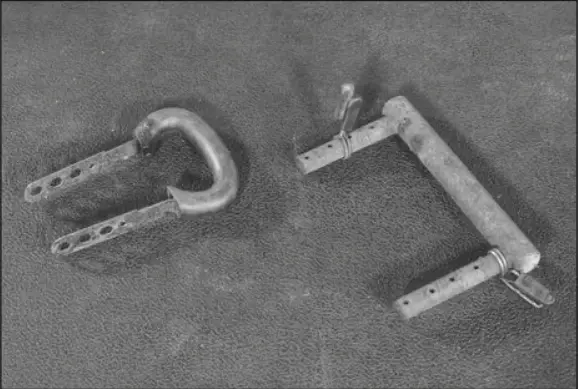
Figure 2.6 Kettlebell handle: single piece and multipiece.

Handle Thickness

Depending on where you get your kettlebell and what kind it is, there can be great variation in handle thickness — from very thin to so thick you can't fit your hand around them. Most kettlebells correspond closely to the international competition standard of approximately 35 mm (1.4 in.).
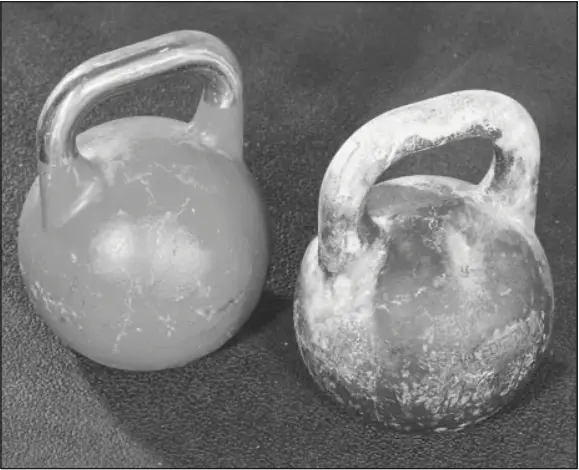
Figure 2.7 Kettlebell handle thickness: 33 millimeters and 35 millimeters.

Women — 33 mm (1.3 in.)

Thick enough to strengthen the hands, wrists, forearms, and fingers — but thin enough to wrap your fingers around the handle.

Men — 35 mm (1.4 in.)

Will challenge your grip but is not too thick to prevent you from performing the exercises.
Don't go thicker than 35 mm for general kettlebell training. Thicker handles are great for hand and grip training, but they are too thick to get the full benefits of high-repetition kettlebell lifting for fitness.
Most kettlebells of 45 lb (20 kg) and heavier have a handle between 33 and 35 mm. Smaller kettlebells typically have thinner handles. Among the various types, only competition kettlebells have a uniform handle diameter, ball diameter, and height.

Spacing, Height, and Length of Handle

You also have to look at the spacing between the handle and the ball.

Too Narrow

Difficult or impossible to put your hand deeply into the handle — important for core lifts like the clean, press, and snatch.

Too Wide

No close fit between the kettlebell and your forearm — the hand is too loose, reducing stability in your movements.

You want the right amount of space — your hand fits into the handle with the sides of the handle next to both sides of your wrist.

Standard Height

55 mm (2.2 in.) from the bottom of the handle to the top of the ball.

Standard Length

186 mm (7.3 in.) from one side of the handle to the other.

Figure 2.8 A standard kettlebell will have sufficient space for you to fully insert your hand into the handle.

Handle Surface

The surface of the handle can be smooth to varying degrees. Many kettlebell brands come with either a painted or powder-coated handle. At low reps (sets of 20 or fewer), these smooth coatings make the kettlebell move smoothly in the hands and may prevent excessive blisters and hand tears. However, they make it harder to grip later in your session and during high-repetition sets when you start to sweat.
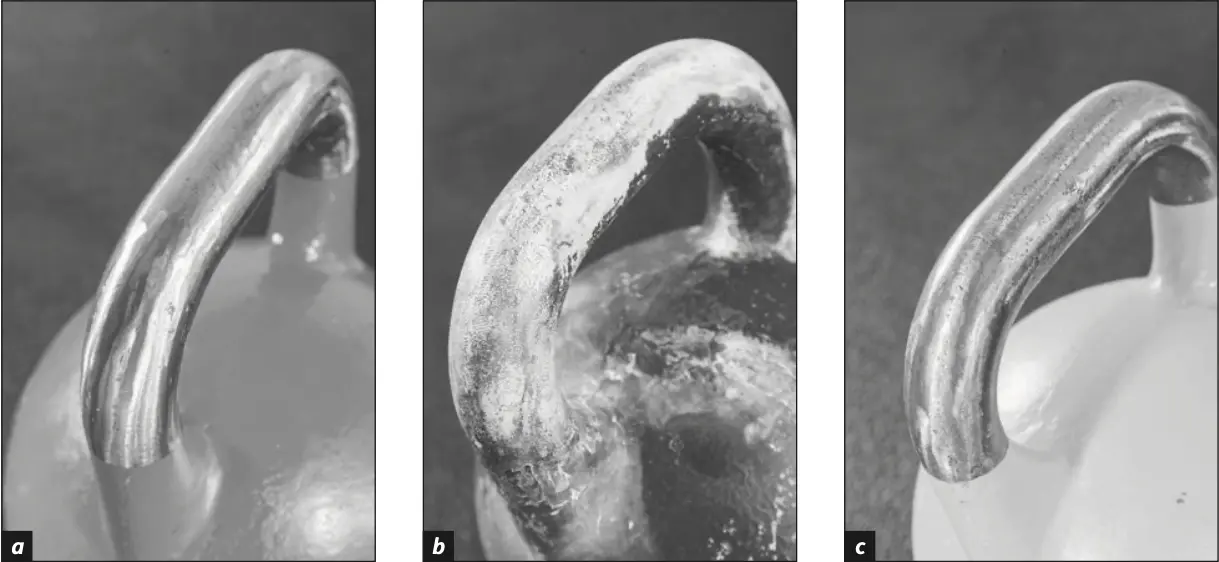
Recommended: a smooth steel-polished handle for serious lifters. No paint, polished bare metal — offers more friction during low reps, better grip when sweaty, and holds chalk much better for high-repetition sets.
Too smooth is just as bad — or worse — than too rough. Some of the worst hand tears come from painted or otherwise too-smooth handles. A handle that is too rough will cut your hands and be uncomfortable.
Fixing a poor handle: if you get a kettlebell that is too rough, use a metal file to work out the rough spots. Some people even use a handheld electric router to smooth rough patches — but be careful not to overdo it.
Keep sandpaper handy. Use it for finishing touches: smooth a too-rough handle, rough up a too-smooth one, or restore a handle's ability to hold chalk. As a kettlebell lifter, your bell is like a baseball player's bat or glove — work it into the perfect feel for your hands.

Figure 2.9 Kettlebell surfaces: (a) a too-smooth handle, (b) a too-rough handle, and (c) a well-prepared handle that is smooth with a bit of roughness.

Diameter and Shape

The kettlebell has a unique design. Some key exercises cannot be done with other weight training implements — or at least not in the same way. There are many important distinctions between the standard barbell or dumbbell clean and the kettlebell clean (which we'll learn about later).

Center of Mass Beyond the Hand

Unlike a dumbbell where the weight sits in the hand, the kettlebell's center of mass extends well beyond the hand. This spacing allows for swinging movements and movements that release and catch the bell.

Sits Against the Body

The design lets the kettlebell sit against the arm or body in almost every exercise — giving greater leverage with more parts of the body in contact with the load.

Strengthens in One Line

The handle position lets the grip, wrist, arm, shoulder, legs, and core strengthen all in one line.

Neutral Wrist Alignment

Inserting your hand deeply into the handle means no cramping or wrist bending. The hand and forearm stay in neutral alignment — much greater endurance than a dumbbell, where the wrist is crooked backward.
If your forearms and grip give out early, you can't hold it. If you can't hold it, you can't swing it!

Durability

Steel — Strongest

Virtually indestructible and lasts the longest. Outdoor or damp use leads to handle rust, so keep sandpaper handy. Some come with an antirust finish, but serious lifters remove this with paint remover for the pure-steel feel.

Cast-Iron — Reliable

Generally strong. Not as strong as steel, but will last almost forever if you don't drop them on a hard surface.

Plastic and Vinyl — Wears Out

Wears out from filling and emptying and from being kept or used outdoors.
You will eventually need to replace the screws that connect the handle to the plates on traditional adjustable kettlebells. If you drop kettlebells frequently — such as during kettlebell juggling — or treat them roughly, the finish will come off faster and they will scratch and mark. This will not affect performance, only appearance.

Weight

Kettlebells typically range from 8 kg (18 lb) up to 48 kg (106 lb), but they can actually go from as light as 2 kg (4 lb) up to almost 90 kg (200 lb). Some people even weld two kettlebells together to make a heavier one.

The pood — Russian unit of measurement. A pood is approximately 16 kg (35 lb). So a 16 kg bell is a 1-pood kettlebell, a 32 kg bell is a 2-pood kettlebell, and so on.

There is no foolproof guide for the perfect weight, but consider: Are you an expert or beginner? In great shape or starting out? Heavy or light-framed? In time, serious lifters gather an assortment of weights — important for adaptation and progressive overload.

Most Men — 16 kg (35 lb)

Get a pair of 16 kg bells to benefit from double-kettlebell training.

Lighter Men — 12 kg (26 lb)

If you're 130 lb (61 kg) or less or have no strength training background, start lighter.

Most Women — 8 kg (18 lb)

Standard starting weight for women beginning kettlebell training.

Athletic Women — 12 kg (26 lb)

Very athletic or already-strong women can start with 12 kg.
When unsure, go lighter. It is always better to start lighter and graduate to heavier kettlebells than the other way around — a good principle for long-term success.

Finish

In some cases, cast-iron kettlebells are covered with a rubber coating or have a rubber base so the bell doesn't scratch the floor.

Rubber-coated kettlebells tend to be unwieldy and bounce when dropped — an annoyance and potentially dangerous if the bell were to bounce back into you. Only advantageous if you'll be setting them down on hardwood floors.

Comfort

It is important to select a kettlebell that is a good match for your body size and fitness level. The weight has to be appropriate for your current strength and conditioning.

As you become stronger and fitter, you'll want to progress to heavier kettlebells to emphasize strength and use lighter kettlebells to emphasize cardiorespiratory conditioning.
Handle thickness vs. hand size: for an average-sized man, a thick handle may not provide enough grip work. For a woman with small hands, a thinner handle may be more appropriate — a thick handle would be difficult to hold onto.

Price

Steel — Highest Quality

The highest quality and most expensive. The pure-steel feel is the gold standard for serious lifters.

Cast-Iron — Best Value

A good combination of quality and price — less expensive than steel and only slightly less durable.

Adjustable — Mid-Range

More expensive per piece, but you need fewer pieces since you can change the weight.

Vinyl & Plastic — Avoid

Least expensive, lowest quality — a waste of money and should not rightly be considered kettlebells.
Recommended: invest in steel or cast-iron only. A good 16 kg (35 lb) cast-iron kettlebell should cost $60 to $100 depending on the company and quality. A comparable steel kettlebell will typically be $5 to $10 more.
Beware Of Vinyl And Plastic KettlebellsVinyl and plastic kettlebells can be found in many sporting goods stores. They are typically the least expensive versions, but they are really only kettlebells in name.They do not perform like a kettlebell, and the shape and design do not allow for proper mechanics of kettlebell training. In most cases the space between the handle and the ball is so narrow that a person could not fit their hand through it.These kettlebells have a plug on the top or side of the ball that can be removed so that water or sand can be added for greater resistance. The only advantages are that they are very cheap and if you drop them there is no damage to the floor or yourself.This type of kettlebell may be a nice introduction to kettlebells for children while they learn the basics of safe practice — but aside from that, it is the least effective type and is not recommended.
Copyright © 2026