What Are Kettlebells?
What Are Kettlebells?
Ten years ago, no one outside of the former Soviet Union knew what a kettlebell was, let alone had ever seen or touched one. Now it seems almost every personal trainer is using kettlebells with their fitness classes and clients.
A Ball With a Handle
Kettlebells have a unique design that sets them apart in form and practice from the more widely known barbell and dumbbell. The word kettlebell comes from the Russian girya — a cast-iron weight resembling a cannonball with a handle. It is the configuration of the handle with the ball that makes kettlebell training unique.
Why the Shape Matters
Unlike traditional dumbbells, the center of mass of the kettlebell is extended beyond the hand. This single design choice is what unlocks everything kettlebell training can do.
Dumbbells & Barbells
Kettlebells
This configuration allows ballistic — fast, swinging — motions that combine cardiorespiratory, strength, and flexibility training while engaging the entire musculature of the body all at once.
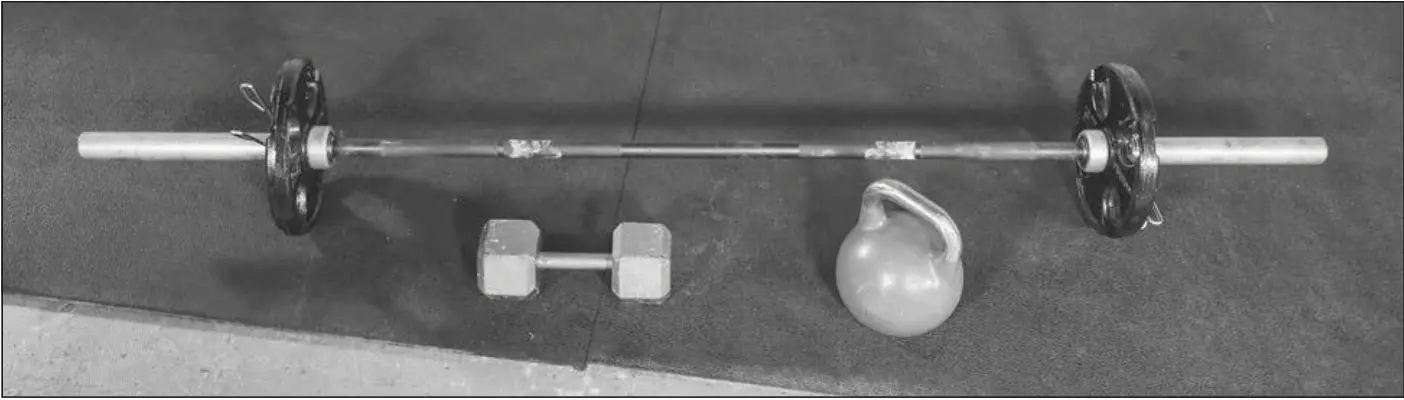
Figure 1.1 Comparison of a kettlebell, a dumbbell, and a barbell.
A Brief History of the Kettlebell
Kettlebells have their origin in ancient Russia, where importance was placed on physical strength.
1704 — First Recorded Mention
The word girya — a traditional Russian cast-iron weight — first appears in a Russian dictionary. At the time, kettlebells were used as counterweights in the local markets of farming villages. Russian farm workers discovered the girya could double as a fitness tool, and informal contests sprang up in remote villages and nearby towns.
1913 — Hercules Magazine
A popular fitness magazine article boosts recognition of kettlebells as a powerful tool for weight loss.
1940s — National Sport of the USSR
Kettlebell lifting becomes the national sport of the Soviet Union. Powerlifters, Olympic athletes, and military personnel all benefit from training with them.
1960s — Schools & Universities
Kettlebell lifting is introduced into Soviet schools and universities.
1970s — Sport Association
The sport joins the United All State Sport Association of the USSR, though no official rules or standards exist yet.
1985 — Formal Recognition
A committee for the sport of kettlebell lifting is created, and girevoy sport (the Russian name for kettlebell sport) becomes a formal sport with competitive rules and regulations. The first USSR National Kettlebell Championship is held in Russia that same year.
Today — Worldwide
Kettlebells are used across athletics, martial arts, and general fitness training around the world. As one example, the 2012 IKFF National Kettlebell Championships drew 175 registered competitors.
The Kettlebell Advantage
Discover why kettlebells are the ultimate all-in-one fitness tool for strength, fat loss, and conditioning.
Kettlebells For Functional Fitness
How functional training shifts focus from isolated muscles to whole-body movement — and why the kettlebell stands out as the leading tool for the job.