Getting Started With Kettlebell

Kettlebell Lifting Attire

What to wear for kettlebell training — gloves, shoes, wrist wraps, weight belts, and clothing that won't get in the way.

Kettlebell Lifting Attire

The clothes you work out in should enable free, unrestricted movement and should in no way interfere with your training.

There is no specific kit you must wear — you'll see lifters in both loose and tight clothing — but a few choices will make or break your sessions.

What To Wear

Gloves

Mostly for beginners — reduce the feel but help while skin toughens up.

Shoes

Hard and flat — Olympic weightlifting shoes, FiveFingers, Converse, or barefoot.

Wrist Wraps

Thin wraps to cushion the forearm while you learn to slip your hand into the handle.

Weight Belt

Worn low, used by serious lifters for the clean and jerk. Not needed for general fitness.

Tops & Bottoms

Cotton, fitted — avoid slick synthetics and baggy crotches.

Gloves

Wearing gloves is more common among less experienced lifters. You will rarely if ever see an experienced or advanced lifter using gloves.

Why advanced lifters skip gloves:
  • They reduce the feel of your hand on the kettlebell.
  • They can bunch up and get caught in the spinning handle.
  • Some add thickness to the hand, making it harder to insert your hand into the handle.
  • This adversely affects the mechanics of the lifts, especially during high-repetition sets.
The best solution is to learn good technique. With good technique, you can move your hand back and forth between the handle and ball without catching or tearing the skin. You learn to toss and catch the moving kettlebell from the fingers to the base of the palm — completely avoiding the handle spinning in your palm and the resulting blisters and tears.
My advice for beginners: start with no gloves. As your hands begin to get tender, slip the gloves on to finish the workout with no tears. With more training, you'll need gloves less and less.
The exception — gloved snatch. Advanced competitive kettlebell lifters perform exercises such as the gloved snatch, but in this case the gloves are workman gloves used to make the grip harder and the kettlebell more difficult to hold.

Shoes

There are a variety of shoes that you can wear while training.

Olympic Weightlifting Shoes

Worn by serious and competitive lifters. Leather with a hard, raised wooden heel and a thin rubber strip on the bottom. The heel elevates the hips for stable cleans and jerks, and the design provides ankle and heel stability for transferring power from the ground.

Vibram FiveFingers

Popular with fitness-focused lifters for the barefoot feel. A great alternative to traditional shoes.

Barefoot

Completely fine. Just be careful to move your feet if you ever drop the kettlebell — quick feet are happy feet!

Flat-Soled Shoes

Something like Converse All Stars — another solid option.
Avoid overly cushioned shoes such as running shoes. Running shoes have too much cushion and are very soft, making it harder to push off the ground. Hard and flat shoes are a better choice for kettlebell lifting.
If you train at a gym or combine running with your kettlebell workouts, bring a second pair of shoes dedicated to lifting.

Wristbands or Wrist Wraps

Wristbands or wrist wraps are optional, but you may want to put some on at least in the early stages of kettlebell training.

What wraps are good for:
  • They cushion your wrist and forearm while you learn to flip the kettlebell over your hand (or more correctly, slip your hand into the handle).
  • There's a learning curve — in the beginning of practice you may bang your wrist and forearm from time to time. With more practice, you'll slide your hand effortlessly through the handle and eliminate the banging almost entirely.
  • If your forearms sweat a lot, wraps help keep the kettlebell in proper alignment on your arm and reduce sweat dripping to your hands and the kettlebell itself.
Don't use thick wraps. Thick ones will impede your ability to fully insert your hand into the handle — the wrap gets caught while you're inserting your hand.Good options:
  • An elastic bandage wrapped around each wrist.
  • Thin canvas wraps fastened with Velcro strips.

Weight Belts

Weight belts are used by serious kettlebell lifters. They are similar to powerlifting belts but not as thick.
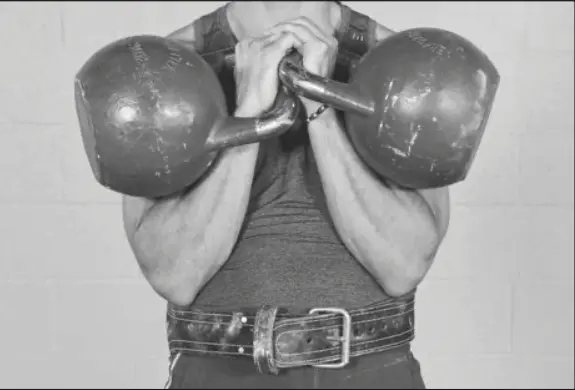
How a kettlebell belt is worn: thin, not tight over the abdomen. Instead, the belt is worn low at the top of your pelvis so that you can gently place your elbows in between the top of the belt and your belly. This lets you relax your shoulders more by resting your elbows on your ilia.

Figure 2.10 The lifting belt is worn loose and low on the hips below the waist so that the lifter can place the elbows between the body and the inside of the belt.

Specifically used for the jerk and the clean and jerk — where an athlete lifts two kettlebells overhead as many times as possible in 10 minutes. The belt helps the athlete relax and regenerate when the kettlebells are on the chest, allowing for a greater volume of work.
This is a higher-level skill and concept. For general fitness training, a weight belt is not needed.

Tops and Bottoms

Tops

The main thing to avoid: T-shirts that are too slick — synthetic fibers or shirts with large slick logos.

Why slick shirts hurt your lifts: once you start to sweat, a slick shirt or logo makes it difficult to hold your arms and forearms against your torso — your arms slide out to the sides. When you're tired and have kettlebells in your hands, this just makes it harder.
This isn't as important for the swing and snatch, because the kettlebell and arm don't stay against the body for long. But for the clean, squat, press, and jerk it's necessary to hold your arms against your body — and slick shirts put you at a mechanical and performance disadvantage.
Wear a simple cotton shirt that will stick to your body and arms when you are tired and sweaty.

Bottoms

Pants can be whatever is comfortable — short or long.

Avoid baggy bottoms. They should fit well in the crotch — when you swing the kettlebell back between your legs (such as during the drop from the snatch), your thumb, fingers, or the kettlebell itself can get caught in the baggy part of the crotch and interfere with your lifting mechanics.
Form-fitting shorts, tights, or cycling shorts are great for kettlebell lifting.
Copyright © 2026