Assessing Fitness
Are You Ready to Lift?
You don't have to be fit or athletic to begin kettlebell training. But you do need some control over your body to train safely and free of injury.
Before you pick up the kettlebell for your first session, run through these four simple tests of core stability, shoulder stability, and hip and trunk mobility. If you pass them, you have the base-level readiness to begin your program with confidence.
The Four Assessments
1. Kettlebell Deadlift
2. Squat
3. One-Arm Press
4. Plank
Assessment 1: Kettlebell Deadlift
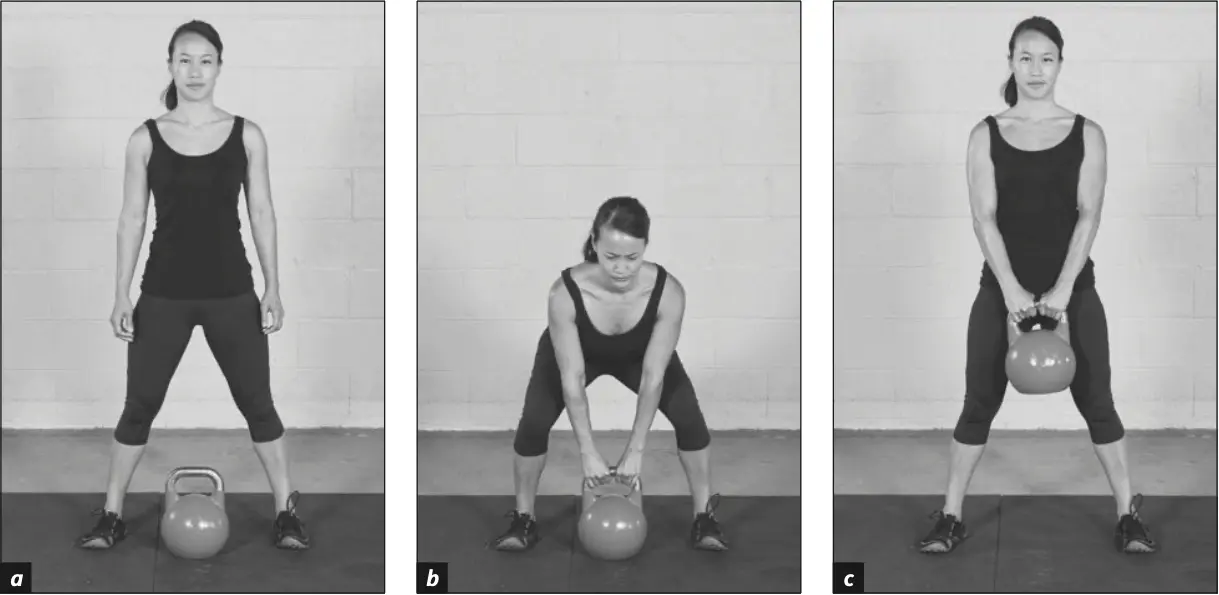
Figure 4.1 Kettlebell deadlift.
With the kettlebell on the ground, stand with your feet shoulder-width apart and the kettlebell just in front of you (figure 4.1a). Keep your chest lifted as you sit back with your hips until your hands can reach the handle (figure 4.1b). Grab the handle with both hands and stand up by pressing your feet into the ground until your body is fully upright (figure 4.1c). Repeat by sitting back to lightly touch the kettlebell to the ground.
Do 10 controlled reps with a light weight, then repeat with a more challenging weight.
Women — Suggested Loads
Men — Suggested Loads
Assessment 2: Squat
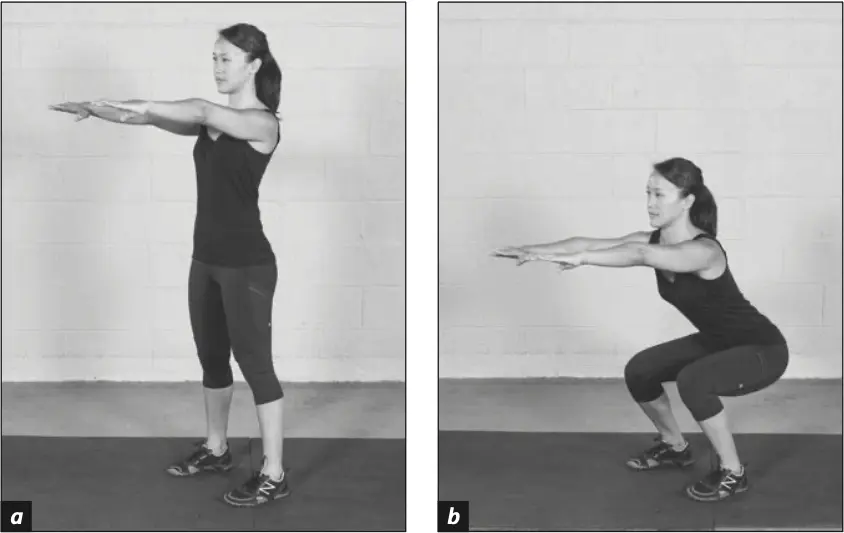
Figure 4.2 Squat.
Stand with your feet shoulder-width apart or slightly wider (figure 4.2a). The right stance varies by person — it might be shoulder-width for you but 1.5× shoulder-width for someone else, depending on flexibility, height, limb length, and leg strength. If you're not very flexible yet, you'll likely feel more stable with feet wider than shoulder-width.
Sit the hips back and down, as if sitting in a chair, keeping your chest lifted and trunk arched as much as possible (figure 4.2b). Press the heels of the feet firmly into the ground — do not let the heels rise or weight shift onto the toes. In the ideal squat, you sit all the way down to full range of motion in the bottom position. From the bottom, stand up by pressing your feet firmly into the ground.
Repeat for 10 repetitions.
Assessment 3: One-Arm Press
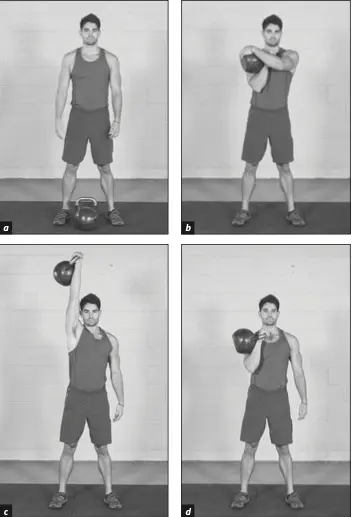
Figure 4.3 One-arm press.
Stand with your feet shoulder-width apart (figure 4.3a). Use two hands to pick up a kettlebell and position it in the working hand (figure 4.3b). Keep your legs straight and your midsection firm — tight but not tense.
Inhale Deeply
Prepare to press.
Press and Exhale
Push the kettlebell directly up over your shoulder, exhaling on the way up. Press until your arm is straight with no bend in the elbow, and the kettlebell is directly over your feet — your base of support (figure 4.3c).
Pause Overhead
Inhale again while the kettlebell is locked out overhead.
Lower
Exhale and let the kettlebell drop back to your chest (figure 4.3d).
Do 3 repetitions with each arm.
Assessment 4: Plank
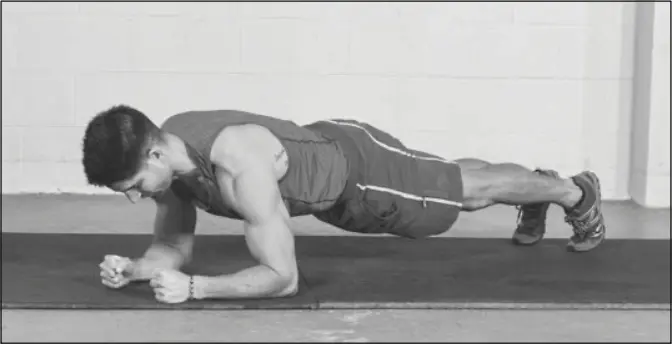
Figure 4.4 Plank.
Start in a facedown position on the floor. Make tight fists with both hands and bend your elbows so each arm forms a right angle between forearm and upper arm. Keep your abdominal muscles tight and hips pressed forward (in line with the spine), and stay balanced on the balls of your feet (figure 4.4). Balance yourself on your forearms and toes with nothing else touching the ground.
Starting Hold
Work Up To
What Your Results Mean
Passed All Four
Struggled With Any
Setting Goals
How to set SMART goals — specific, measurable, attainable, relevant, and timely — that turn vague intentions into a concrete kettlebell training plan you can actually follow.
Training Safely
Best practices for kettlebell training — quality over quantity, monitoring exertion, warm-up and cool-down, taking your time, and staying injury free for the long haul.